
New paper

New preprint: how “cyborg propaganda” blurs the line between grassroots activism and influence operations

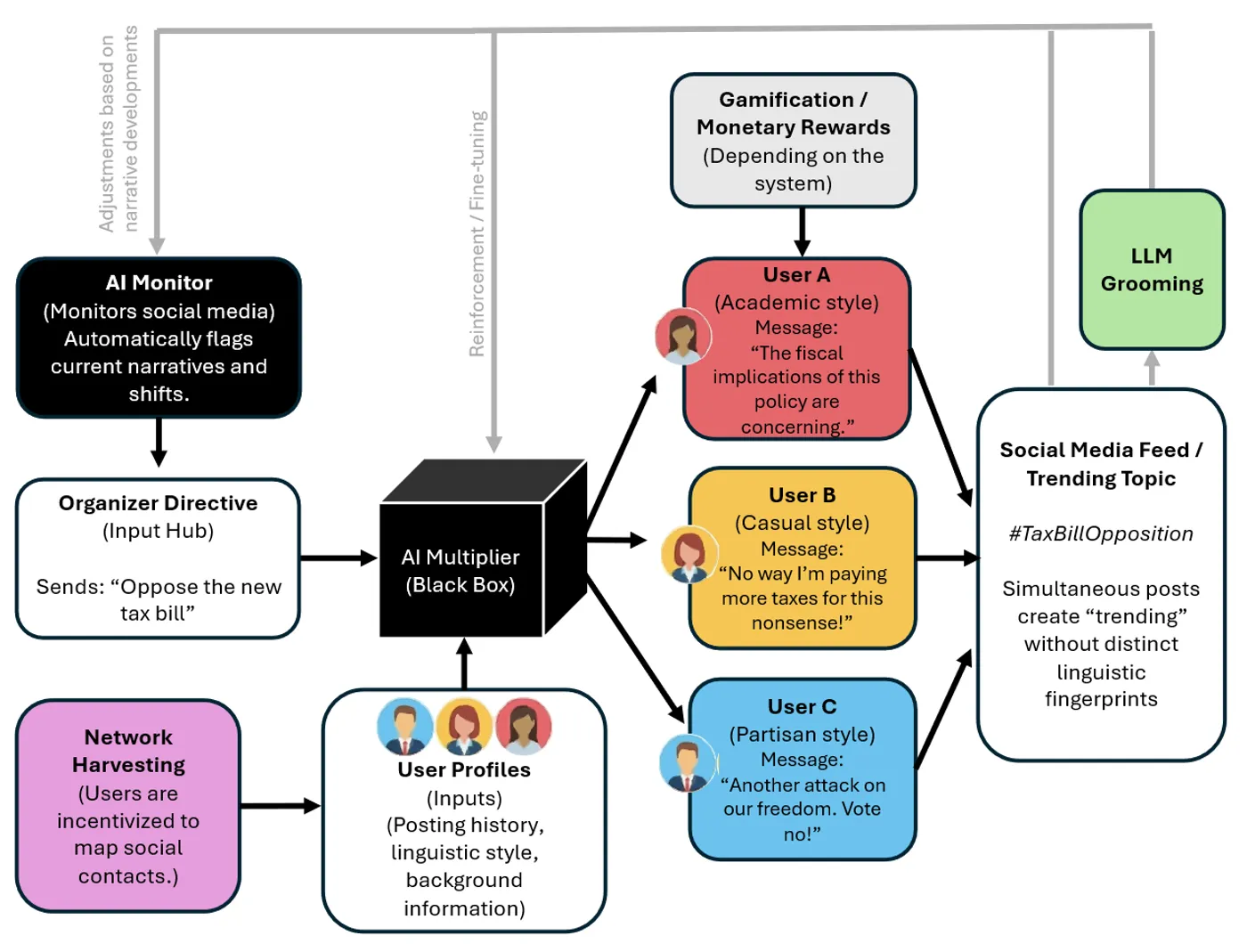
A new preprint on ArXiv by center faculty member Jonas R. Kunst, with center members Anton Gollwitzer and Live Leonhardsen Wilhelmsen among the coauthors, develops the concept of “cyborg propaganda”—campaigns that use verified citizens to ratify AI-generated messages—and argues that frameworks built on a human/bot binary cannot address it. The paper sets out three regulatory responses and shows why their viability differs across democratic and non-democratic contexts.

A conceptual analysis introducing “cyborg propaganda”—a closed-loop architecture that pairs verified human accounts with algorithmic automation to produce personalized political content at scale, ratified by real citizens. Because these campaigns rely on genuine humans to sign off on AI-generated messages, they slip through regulatory frameworks built on a human/bot binary, such as the EU AI Act and Section 230. The paper proposes three responses—classifying coordination hubs as political action committees, mandating researcher access to platform data, and setting risk standards that penalize amplification of synthetically coordinated content—and finds that democratic states are both most capable of regulation and most constrained by the rule of law.
ArXiv.org · 2026

How cyborg propaganda reshapes collective action

Jonas R. Kunst et al.

Abstract

The distinction between genuine grassroots activism and automated influence operations is collapsing. While contemporary policy debates prioritize fully autonomous generative agents and synthetic content, this paper offers a conceptual contribution: we develop 'cyborg propaganda,' a closed-loop architecture combining verified human accounts with algorithmic automation to generate personalized content at scale, as a distinct and undertheorized threat to democratic discourse. By relying on verified citizens to ratify AI-generated messages, these campaigns exploit a regulatory gray zone that frameworks built on the human/bot binary (including the EU AI Act and Section 230) are structurally unable to address. Drawing on a conceptual analysis of coordination platforms and comparative examination of governance frameworks across democratic and non-democratic contexts, we analyze this paradox across micro, meso, and macro levels. We examine whether cyborg propaganda democratizes political power by unionizing influence or reduces citizens to cognitive proxies of a hidden directive, arguing that it shifts political discourse from a contest of ideas to a battle of algorithmic campaigns. We propose three regulatory responses: classifying coordination hubs as political action committees to enforce supply-chain transparency; mandating researcher access to platform data through DSA-style mechanisms; and establishing risk standards penalizing amplification of synthetically coordinated content. Comparative analysis reveals that viability varies structurally. Democratic states are simultaneously the most capable of regulation and the most rule-of-law constrained. By contrast, non-democratic actors face no comparable accountability, making international risk standards the primary cross-border enforcement mechanism.

Read the full article ↗ Read more →

Figure from the article: “How cyborg propaganda reshapes collective action”
Figure from the article

Read more →