
New paper

New preprint: does an AI's national origin change how persuasive it is?

A new preprint on arXiv, coauthored by faculty member Jonas R. Kunst and PhD member Yannic Hinrichs, finds that U.S. participants assimilated a chatbot’s arguments regardless of whether it was labeled American or Chinese—withholding social trust from a rival’s AI but still updating their attitudes toward it.

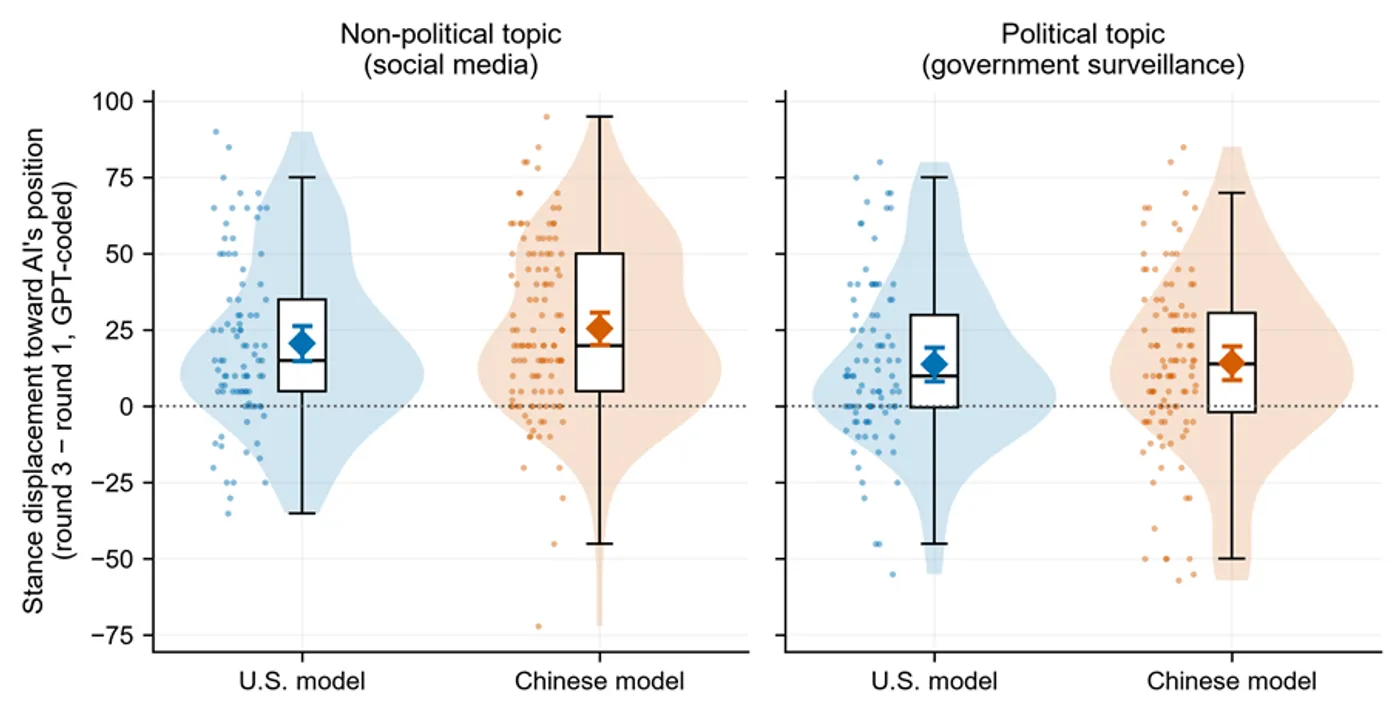
A preregistered experiment in which 403 U.S. adults held a three-round debate with a chatbot labeled as either American ("DiscoveryAI") or Chinese ("ZhengheAI")—though all participants actually conversed with the same model (GPT-4o) arguing against their initial position. Conversations produced substantial attitude change in every condition, and the nationality label affected neither attitude change nor expressed stance, concessions, counterarguing, or affect; its only reliable trace was lower pre-conversation social trust in the Chinese-labeled model. Users withhold social trust from a rival's AI yet still absorb its arguments, suggesting that origin labeling and transparency requirements offer weak protection against foreign influence operations run through conversational AI.
arXiv (Cornell University) · 2026

The persuasive power of large language models does not depend on their perceived national origin

Ningzhi Liu et al., with Yannic Hinrichs and Jonas R. Kunst

Abstract

Conversational AI developed by geopolitical rivals reaches citizens worldwide, raising concerns that it could sway public opinion or be rejected as foreign propaganda, with consequences for democratic discourse and information sovereignty. Yet, whether an AI's perceived national origin shapes its persuasive power is unknown. In a preregistered randomized experiment, 403 adults from a nationally representative United States sample held a three-round debate with a chatbot introduced as either American ("DiscoveryAI") or Chinese ("ZhengheAI"), discussing a political or non-political topic. In all conditions, participants actually conversed with the same model (GPT-4o), instructed to argue against their initial position. We combined pre- and post-conversation self-reports of attitudes, trust, and collective narcissism with computational analyses of 1,209 participant turns, including LLM-coded stance and argumentative conduct, stance-sensitive embeddings, and keyword-masked emotion and toxicity classifiers. The conversations produced substantial attitude changes in every condition. Critically, the nationality label affected neither self-reported attitude change nor expressed stance, concessions, counterarguing, or affect, and equivalence tests and Bayes factors largely supported these null effects. The label's only reliable footprint was lower pre-conversation human-like trust in the Chinese model, whereas functionality trust was unaffected. Political topics slowed stance movement toward the AI's position, and collective narcissism predicted less attitude change regardless of origin, acting as a general barrier rather than an out-group filter. Users thus initially withhold social trust from a rival's AI yet still assimilate its arguments; origin labeling and transparency requirements alone may offer weak protection against foreign influence operations conducted through conversational AI.

Read the full article ↗ Read more →

Figure from the article: “The persuasive power of large language models does not depend on their perceived national origin”
Figure from the article

Read more →