New preprint: why people worldwide expect a dystopian future
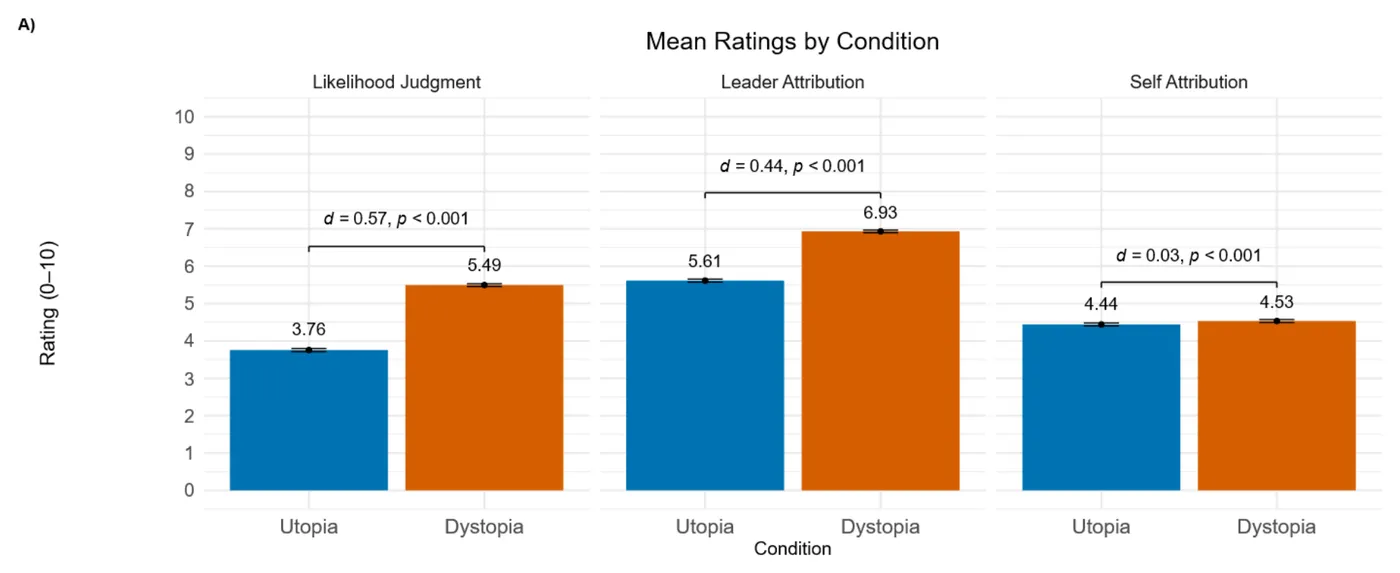
A new preprint on PsyArXiv by center faculty member Jonas R. Kunst, with Hallgeir Sjåstad and Ann-Cathrin Coenen, documents widespread collective pessimism across 40 countries and traces it to the belief that political leaders can do more to bring about dystopia than utopia.
Four pre-registered experiments across 40 countries (N = 52,508) find that people worldwide expect a dystopian future to be far more likely than a utopian one, even as personal optimism remains common. This collective pessimism was driven by asymmetric external attribution: participants believed political leaders can shape dystopian outcomes more than utopian ones, named a specific leader nearly twice as often when imagining dystopias, and rated such personalized dystopias as more probable. The pattern was stronger among left-leaning individuals and in rich democracies but generalized across ideologies and world regions.