

Global Collective Pessimism: People predict a dystopian future and attribute it to political leaders
In brief
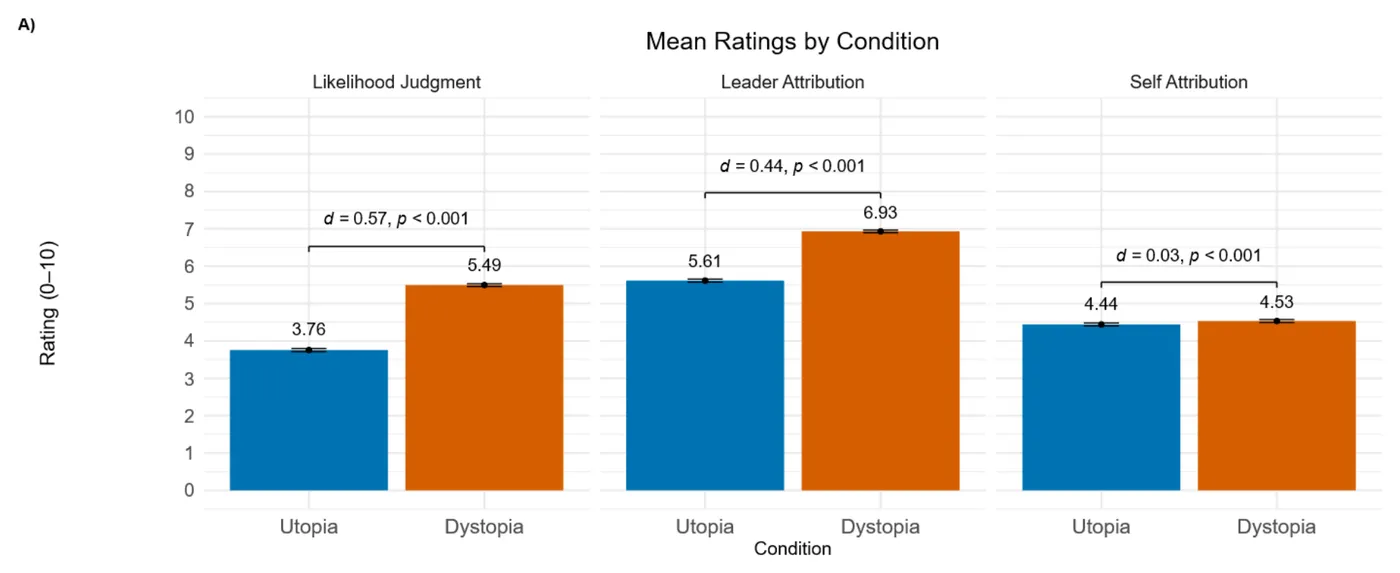
Four pre-registered experiments across 40 countries (N = 52,508) find that people worldwide expect a dystopian future to be far more likely than a utopian one, even as personal optimism remains common. This collective pessimism was driven by asymmetric external attribution: participants believed political leaders can shape dystopian outcomes more than utopian ones, named a specific leader nearly twice as often when imagining dystopias, and rated such personalized dystopias as more probable. The pattern was stronger among left-leaning individuals and in rich democracies but generalized across ideologies and world regions.
Abstract
Personal optimism is widespread. This research provides cross-cultural evidence for collective pessimism. Across four pre-registered experiments in 40 countries (N = 52,508), people believed it is much more likely that a future dystopian society will materialize than a utopian society. Dystopian predictions were driven not by internal attribution, but by asymmetric external attribution: People believed political leaders in society can exert greater influence on dystopian than utopian world development, and high leader impact was correlationally and causally linked to higher scenario likelihood. Text-based analyses revealed that participants named a political leader nearly twice as often in dystopias than utopias, and such personalized dystopias were considered more likely. Dystopian predictions were stronger among left-leaning individuals and in rich democracies, yet generalized across ideologies and world regions.