

Can AI Debias the News? LLM Interventions Improve Cross-Partisan Receptivity but LLMs Overestimate Their Own Effectiveness
In brief
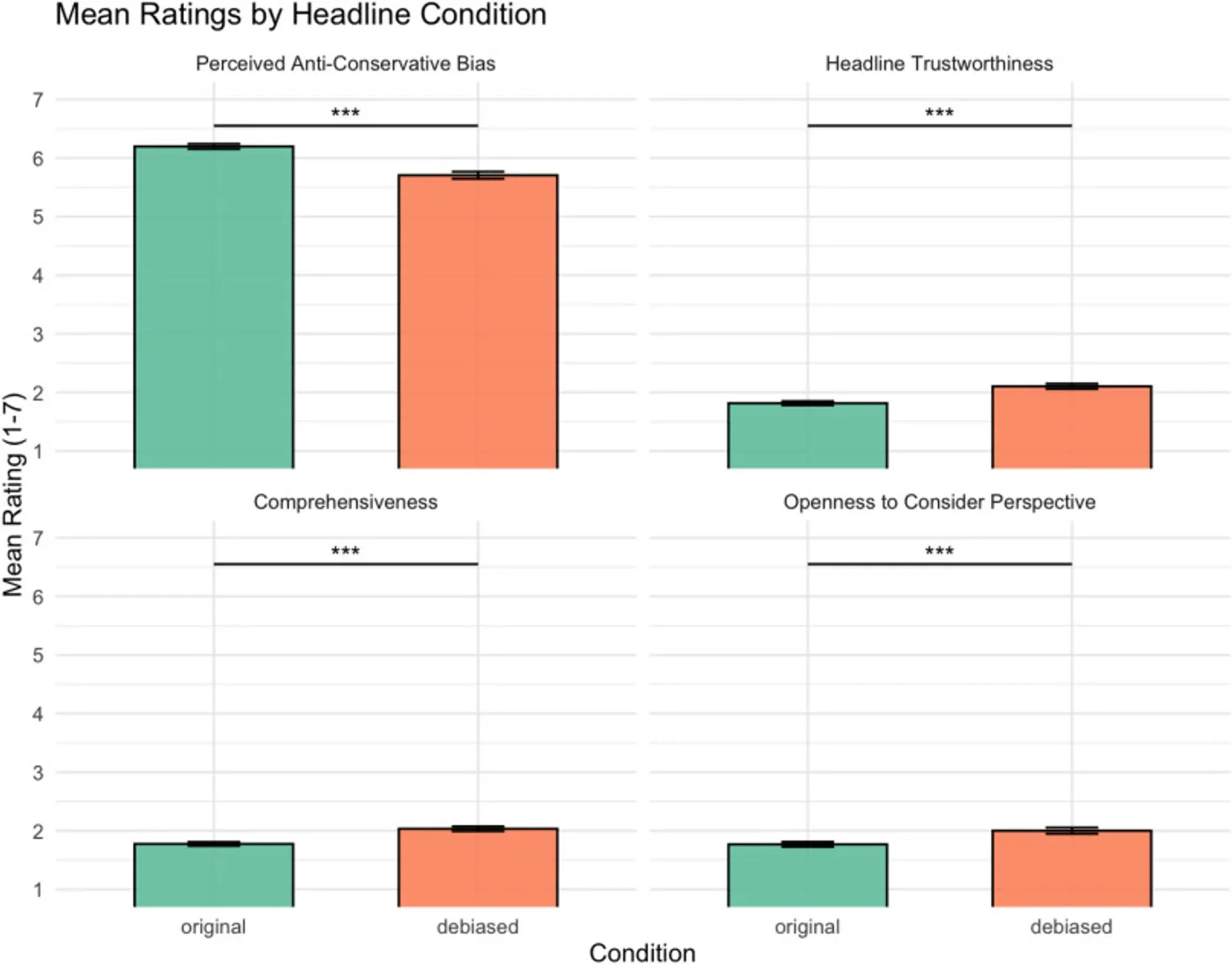
Two pre-registered experiments tested whether LLM-generated debiasing of liberal news headlines could improve conservative readers' trust-relevant judgments. Subtle lexical swaps (replacing emotive words with moderate synonyms) had no effect, but a more substantive reframing intervention significantly raised conservatives' perceived trustworthiness, sense of completeness, and willingness to engage—without a backfire among liberals. Across six models used to simulate "silicon participants," the LLMs overstated their own effectiveness and misjudged who would respond, predicting a nonexistent liberal backfire and stronger effects among high political in-group identifiers not seen in humans.
Abstract
Partisan news media erode cross-partisan trust, but large language models (LLMs) offer a potential means of debiasing such content at scale. Across two pre-registered experiments, we tested whether LLM-generated debiasing of liberal news headlines could improve conservative readers' trust-relevant judgments. Study 1 found that subtle lexical debiasing (replacing emotive words with moderate synonyms) had no effect on any outcome. Study 2 found that a more substantive reframing intervention significantly increased conservatives' perceived trustworthiness, completeness, and willingness to engage with liberal news headlines, without producing a backfire effect among liberals. In Study 1, the intervention produced robust effects across silicon participants simulated with six different models (o3-mini, o3, GPT-4o mini, GPT-4o, GPT-5 mini, and GPT-5), whereas it had no impact on human readers. In Study 2, the intervention's effects among silicon participants generally aligned directionally with human responses but were significantly larger for some outcomes, and three models (o3, GPT-4o mini, and GPT-4o) incorrectly predicted a liberal backfire effect absent in humans. Moderation analyses tentatively suggest that the models’ implicit theory of who responds to debiasing diverged from the psychological profile that actually predicted human responsiveness. Most strikingly, in Study 2, participants simulated by each of the six models suggested that debiasing effects would be stronger among participants high in political in-group identification. Yet, no such moderation was observed among human participants. Collectively, these findings suggest that LLM-based debiasing can improve cross-partisan receptivity when the intervention targeted ideological framing but not when it was limited to the minimal surface-level substitutions tested in this research — and that current models lack both the quantitative accuracy and qualitative psychological fidelity to evaluate their own interventions without human oversight.