

The prose penalty in AI-assisted authorship
In brief
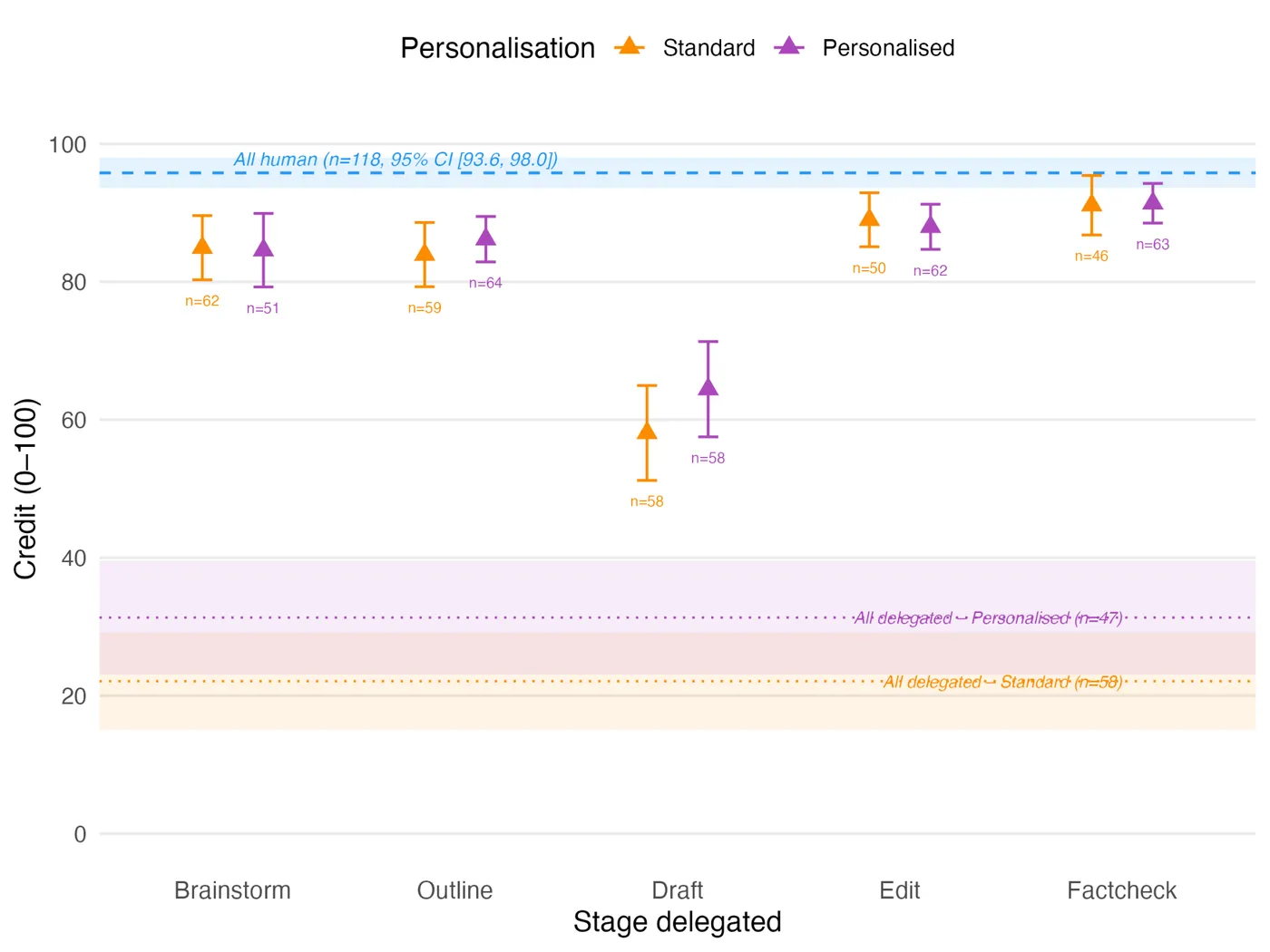
Across two preregistered studies (N = 878 U.S. participants), observers rated a writer who either worked unaided or delegated brainstorming, outlining, drafting, editing, fact-checking, or all five tasks to an AI or human assistant. Delegating any single task lowered authorship credit, but by far the steepest “prose penalty” came from handing off the drafting itself—regardless of whether the helper was AI or human—and credit tracked perceived originality rather than effort or skill. Using an AI personalized on the writer’s own prior work partly restored both authorship credit and perceived writing quality.
Abstract
Generative AI based on large language models (LLMs) is increasingly used in academic, journalistic, and other professional and online writing, yet its implications for human authorship remain contested. We asked whether assignment of authorship credit depends on which task within the larger writing process a writer delegates to an AI assistant; whether any observed credit penalty is unique to AI; and whether credit can be restored through personalization: using an AI trained on one’s own previous writing. Across two preregistered studies (N = 878 US participants), observers evaluated a writer who either wrote unaided or delegated brainstorming, outlining, drafting, editing/revising, fact-checking, or all five tasks to an LLM or human assistant. In Study 1, although delegating a single task reduced authorship credit on average, the largest penalty by far applied to delegated drafting of prose, regardless of whether the helper was human or AI. Only the perceived originality needed for each task was independently associated with differences in credit assignment; perceived effort and skill were not. Perceived writing quality was also lower with LLM than human assistance, despite evaluated passages being randomly drawn from the same pool. In Study 2, using an LLM personalized on the writer’s own prior work increased both authorship credit and perceived writing quality relative to using a standard LLM. These findings show that authorship judgments depended principally on whether the writer produced the prose, regardless of helper type; that credit tracks judgments of originality, rather than effort or skill; and that the “prose penalty” on authorship attributions in AI-assisted writing can be partially reduced through personalization.